



-
Co-creative development
-
Precision at scale
-
European Production

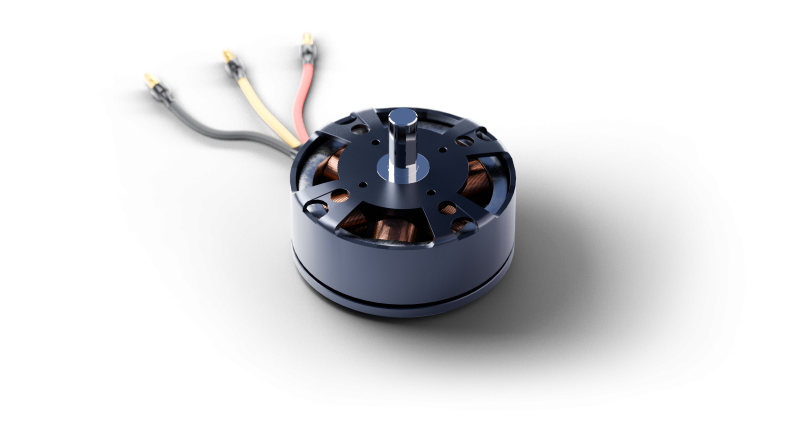
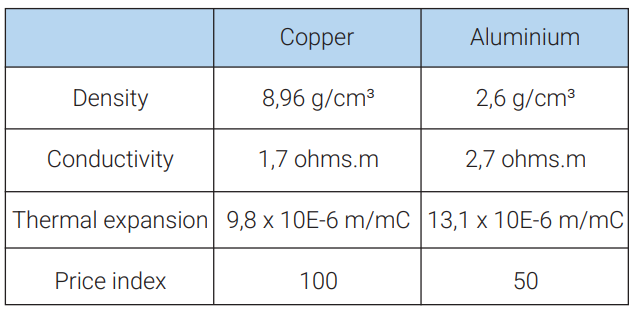
Replacing copper with aluminium conductors has been discussed for many years. The discussion has mainly been driven by price versus conductivity and only occasionally driven by a potential weight reduction. But when looking at the physical properties in table 1 below it is obvious that an exchange from copper to aluminium can play a major role in weight reduction of electrical motors.
Back in the 1970’s several motor producers manufactured motors with aluminium windings, but the higher resistivity combined with difficulties in the connections made the market go back to copper windings.
Today the access to both copper and electrical steel is influenced by potential shortage mainly caused by the global focus on electrification with the automotive industry as a major driver. This has resulted in severe price increases, long delivery times and even shortage in some areas. Due to the higher losses in aluminium the thickness of the wire has to be increased by 26% in order to carry the same current. Therefore, aluminium wired motors are typically larger than copper winded motors. In order to level out this difference a stator design reducing the length of the windings can be introduced hence reducing the size again. Such a design is shown in figure 1 for a motor mounted with a ferrite rotor. The ferrite magnet is chosen amongst other considerations in order to avoid the price and delivery fluctuations seen over the last years on neodymium based magnets.
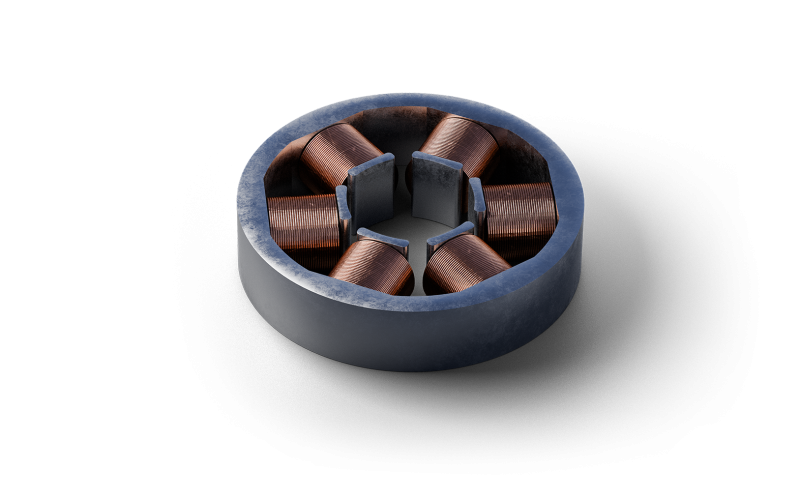
The difficulties with the connections that were observed in the 1970’s have also been targeted and today many motor producers are using high-pressure, piercing crimp connectors or other combining solutions. A generic motor design has been chosen in this case in order to give inspiration to the reader, but a real motor has to be optimized toward the parameters most important for a specific application, optimizing for price, performance, motor size, weight or sustainable parameters.
At Sintex we are always willing to help motor designers with the initial simulations to ensure that the final design does not only fulfil the specifications but also can be produced on industrial scale. We have several computer simulation programs with different complexity and accuracy, amongst others accurate Comsol Multiphysics finite element and the analytical and fast simulation program SPEED.
In this case we have calculated on a motor based on the material STX B7X for the stator with the following specifications:
• Stator outer diameter: 80 mm
• Stator length: 20 mm
• Stator teeth: 6
• Rotor outer diameter: 28 mm
• Ferrit-Rotor
• Poles: 4
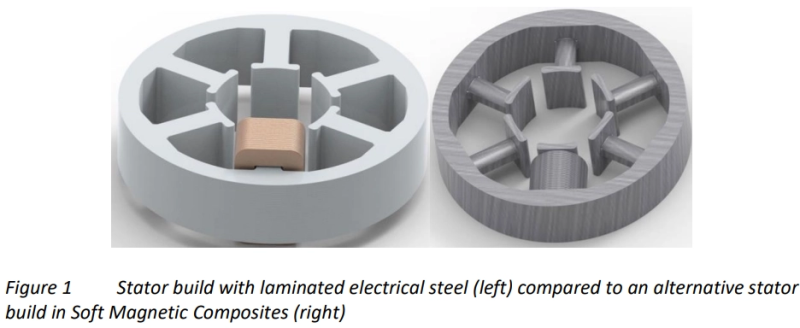
If we compare the design with and without the lowered teeth height there is a potential of weight reduction from 412 til 310 grams as shown in Table 2 below. But a further weight reduction can be found if the copper is exchanged with aluminium even if the aluminium wire is increased in thickness. The weight reduction potential in this case is as large as 159 grams (from 412 to 253 grams) in the stator alone.
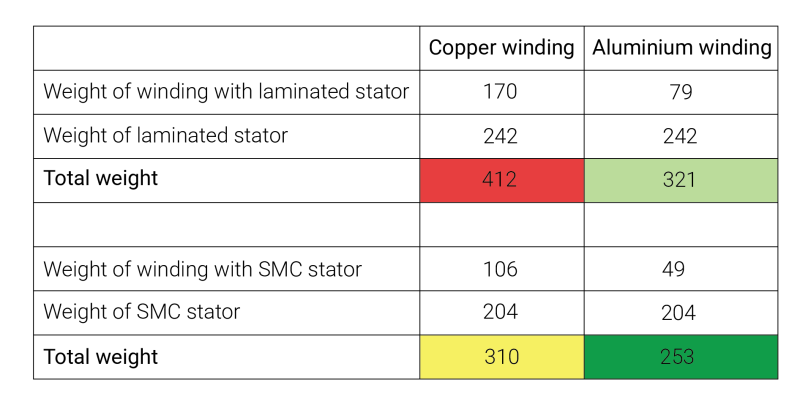
Figure 2: Stator weight with different designs and material choice. The diameter of the aluminium wire hase been increase with factor of 1,26 in order to carry the same current.
The latest report from IHS Markit on shortage risk for electrical steel shows that the majority of the steel mills are placed in Asia and that a shortage is expected already in 2023. The shortage is caused by the strong growth in electrification of transportation – a growth rate that cannot be followed by the existing steel mills supplying the electrical steels for the stators. The large OEM companies will be served first which leaves the smaller motor producers to find alternative
solutions. One of these could be SMC which is a powder metallurgical based material manufactured in Europe. As is the case for laminated electrical steel there are also several grades within the world of SMC optimized for different applications as high frequencies, high mechanical strength or low losses.
SMC is made with powder particles that are electrically isolated from each other with a thin layer of a ceramic coating. Due to the nature of the ceramic coating SMC is not a ductile material, which can be used to separate the stator from the winding during disassemble at the end of life for the product. As a part of design for disassembly the stator can be crushed and the iron can easily be separated from the windings with a magnetic separator.
It is expected that the losses of an aluminium wound motor are a little larger than a similar motor with copper windings. Therefore this solution is mainly targeting motors that are only running occasionally and where weight reduction is important. This could be the case in transportation, where many small motors are transported for hours without being activated.
For such a motor the carbon emissions are often higher due to the transportation than for the motor being used itself. Therefore it is strongly recommended to look deeper into smaller motors and analyze if the carbon footprint is dominated by passive transport or by activating the motor itself.
The given motor example was calculated with materials that was chosen to mitigate the forecasted risks on shortage price increase and sustainable questionable materials. Therefore ferrite magnets were chosen over neodymium, SMC were chosen over electrical steel and aluminium windings were chosen over copper.
By changing the original design with laminated steel into the SMC version with a reduced height of the bridge the stator weight itself will be reduced from 242 to 204 grams and a further weight reduction can be harvested when exchanging the copper wire with aluminium windings resulting in a final weight on 253 grams – a weight reduction on 159 grams.
By choosing the best design and materials for your application it can be possible to
• Reduce motor weight
• Reduce and stabilize price
• Reduce carbon footprint
• Design for disassembly- And secure a stable supply chain for your next generation stator.
To learn more about our materials and motor competencies at Sintex please feel free to contact us.
This site is protected by reCAPTCHA and the Google Privacy Policy and Terms of Service apply.
This site is protected by reCAPTCHA and the Google Privacy Policy and Terms of Service apply.
This site is protected by reCAPTCHA and the Google Privacy Policy and Terms of Service apply.